


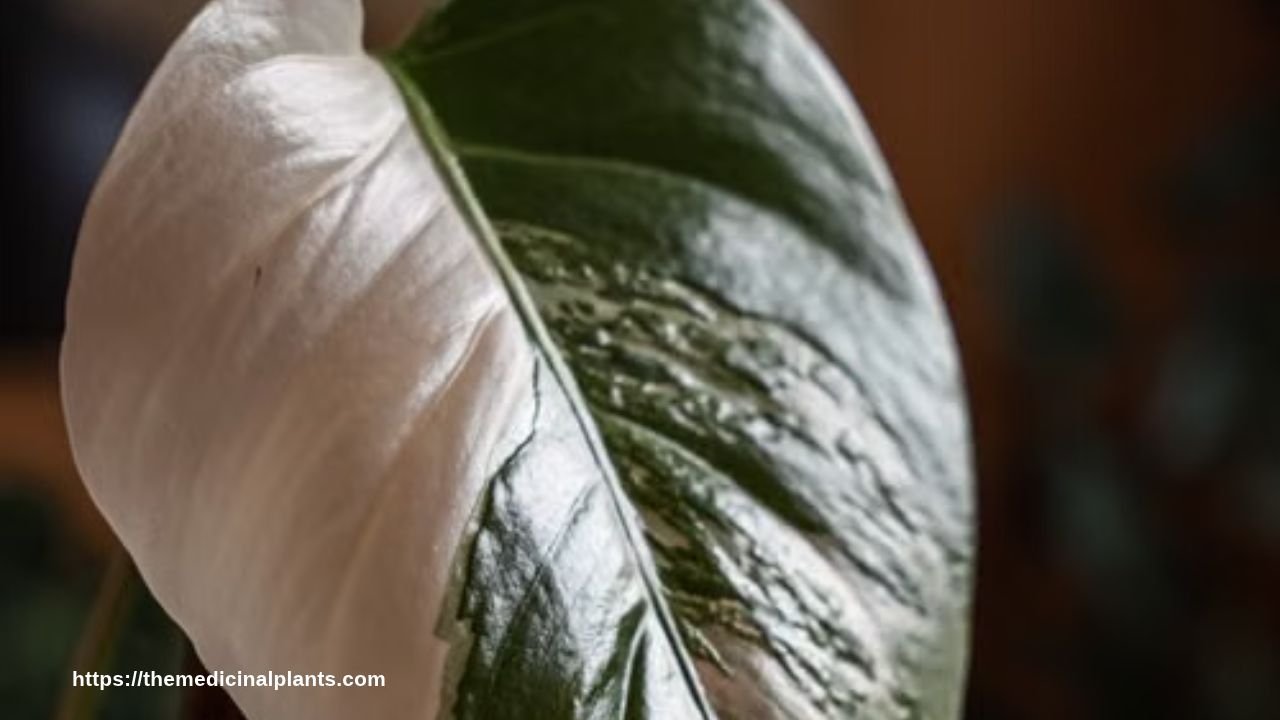
Common Names
– Variegated Monstera standleyana
– Albo Monstera standleyana
– White Variegated Monstera
– Five Holes Plant (occasionally used in the trade)
Scientific Name
Monstera standleyana ‘Albo Variegata’
Parent species: Monstera standleyana G.S.Bunting
Some Basic Information about Monstera standleyana ‘Albo Variegata’ - Indoor house plant
Habit – Perennial, evergreen, climbing or hemiepiphytic herb, capable of growing several meters long when provided with suitable support. The plant develops a slender, elongated climbing stem with distinct nodes and produces leaves along the stem. It climbs trees and other supporting structures with the help of aerial roots.
Root – Root system consisting of underground roots and aerial roots arising from the nodes of the climbing stem. Aerial roots are relatively thick and help the plant attach to supporting surfaces. They may also absorb moisture and nutrients from the surrounding environment. Underground roots absorb water and minerals and anchor the plant in the growing medium.
Stem – Stem slender, cylindrical, fleshy, and climbing, with distinct nodes and internodes. Leaves, aerial roots, and new shoots arise from the nodes. Young stems are green and flexible, while older stems become stronger as the plant develops. Aerial roots emerge from the nodes and provide support during climbing.
Leaf – Leaves simple, alternate, petiolate, leathery, glossy, and elliptic to lance-shaped, with an entire margin and pointed apex. Unlike Monstera deliciosa, the leaves generally do not develop deep marginal lobes or internal fenestrations. The leaf surface is smooth, with a prominent midrib and visible lateral veins.
Leaf Arrangement – Leaves are arranged alternately along the climbing stem, with each leaf arising from a distinct node. They are generally held outward or slightly upward along the stem. New leaves emerge rolled and gradually expand into their characteristic elongated shape.
Inflorescence – Inflorescence consisting of a fleshy spadix surrounded by a modified leaf-like structure called a spathe. It arises from the stem when the plant reaches sufficient maturity and growing conditions are suitable.
Flower – Flowers small, numerous, and densely arranged on the surface of the spadix. Individual flowers are inconspicuous and closely packed together, forming a compact cylindrical floral structure characteristic of the family Araceae.
Perianth – Perianth absent, as characteristic of Monstera standleyana. The individual flowers lack a conspicuous floral covering.
Androecium – Stamens present in numerous closely packed flowers along the spadix. The anthers produce pollen grains that are released during the flowering process.
Gynoecium – Gynoecium composed of fused carpels. Ovary superior, containing ovules that develop into seeds following successful fertilization. The ovaries are closely packed within the spadix and develop into fleshy fruiting units as the fruit matures.
Fruit – Fruit develops as a fleshy, elongated structure composed of closely packed fruiting units along the spadix.
Seed – Seeds develop within the fleshy fruiting units following successful fertilization. Sexual reproduction through seeds is possible.
Floral Formula – Br ⚥ P₀ A₄ G(2)
Kingdom – Plantae
Clade – Angiosperms
Clade – Monocots
Order – Alismatales
Family – Araceae
Subfamily – Monsteroideae
Tribe – Monstereae
Genus – Monstera
Species – Monstera standleyana
Uses of Monstera standleyana ‘Albo Variegata’ House Plant
Indoor housePlant – It is widely cultivated as an ornamental plant in homes, apartments, offices, and other indoor spaces.
Small-Space Gardening – Although it has a spreading and climbing growth habit, it does not occupy a large amount of space. Consequently, it is well-suited for containers, apartments, and areas with limited room.
Vertical Gardening – Due to its climbing nature and the presence of aerial roots, it can be easily grown using a moss pole, trellis, or other vertical supports.
Landscaping – In regions with warm, favorable climates, it can be grown in containers or incorporated into tropical-style gardens.
Plant Collections – Because of the unique white patterns on its foliage, it is highly popular among home gardening enthusiasts and collectors of tropical plants (aroids).
Related article
- Comparison Between Hoya, Burro’s Tail, and Wandering Jew Hanging Plants
- Hanging plant- Inch Plant: Floral formula
- Hanging plant- Burro’s Tail: Floral formula
- Hanging plant-Hoya: Floral formula
- Hanging plant-hedera helix: Floral formula
- Hanging plant-Boston Fern: Floral formula
- Hollyhock (Alcea rosea): Plant overview and floral formula
- Helianthus annuus floral formula
- Chillies and Peppers at Home – Step-by-Step Guide
- Tomato at home – step to step Guide
- Chives at Home – Step-by-Step Guide
- Conophytum Succulents at Home: Step-to-Step guide
- Edamame (Young Soybeans)
- Lettuce at Home: Step-to-Step guide
- Brassica campestris at home step to stpe guide