
The Snake Plant (*Dracaena trifasciata*) is an evergreen succulent House plant featuring a short stem and an underground rhizome (a root-like stem). It grows in dense clusters of upright, thick, sword-shaped leaves marked with distinctive green or yellow patterns. The plant produces small, fragrant, greenish-white flowers on long stalks, followed by fleshy berries. Its water-storing leaves, ability to grow from rhizomes, and use of CAM photosynthesis allow it to thrive easily even in low-water environments. It is widely cultivated as an indoor ornamental plant due to its attractive foliage and drought tolerance; it can also grow readily in low-light conditions.
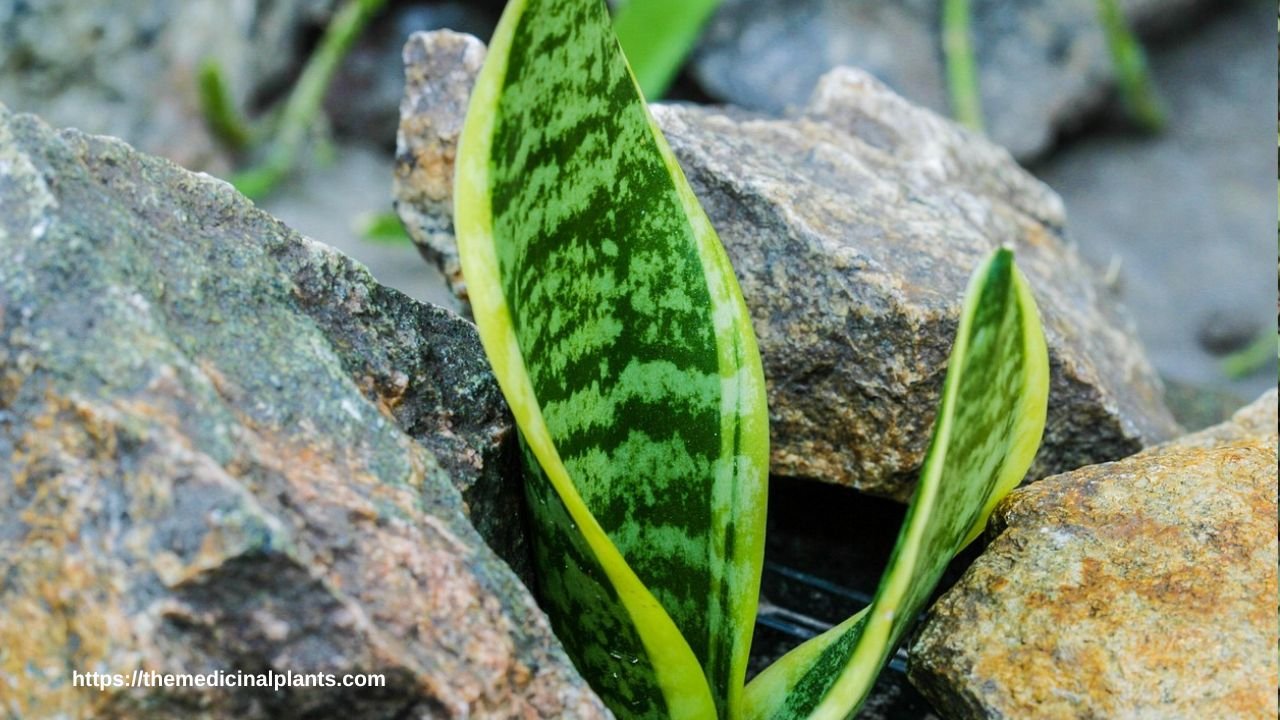
Scientific Name: Dracaena trifasciata
Common Names– Snake Plant
Mother-in-Law’s Tongue– Viper’s Bowstring Hemp
Scientific Name – Dracaena trifasciata Prain
Former scientific name: Sansevieria trifasciata Prain
Some Basic Information about Snake Plant (Dracaena trifasciata) - Indoor house plant
Habit – Perennial, evergreen, succulent herb, usually 30–120 cm tall, forming dense clumps or rosettes from an underground rhizome. Mostly stemless above the ground and produces erect, rigid leaves.
Root – Root system fibrous and fleshy, arising mainly from the underground rhizome. Roots are relatively shallow and spreading and function in water and mineral absorption. New roots also develop from the rhizome during vegetative propagation.
Rhizome – Underground rhizome thick, fleshy, creeping or branching, and capable of storing water and nutrients. It produces new shoots and roots and enables the plant to form dense clumps. The rhizome is an important means of vegetative reproduction.
Stem – Aerial stem very short or highly reduced, with leaves arising closely from the base and forming a compact rosette or cluster. A separate, slender flowering stalk develops when the plant flowers. The underground rhizome represents the principal stem-like structure.
Leaf – Leaves simple, sessile or shortly petiolate, erect, rigid, succulent, linear-lanceolate to sword-shaped, with a pointed apex and entire margin. Leaf surface is smooth and waxy, helping reduce water loss. Leaves are generally dark green with lighter grayish-green transverse bands. In some cultivars, the leaves possess distinctive yellow margins or silvery coloration.
Leaf Arrangement – Leaves arise from the base in a dense basal rosette or cluster. They are generally upright and closely packed, giving the plant its characteristic sword-like appearance.
Inflorescence – generally racemose or spike-like, borne on a long, slender flowering stalk arising from the base of the plant. Small flowers occur in clusters along the stalk.
Flower – Small, bracteate, complete, actinomorphic, bisexual, and fragrant. usually greenish-white, cream-colored, or pale green and may open more strongly during the evening or night. The flowers are tubular or narrow and attractive because of their pleasant fragrance.
Perianth – Perianth consists of 6 tepals, arranged in two whorls of three. Tepals are narrow, tubular to slightly curved, and generally greenish-white or cream-colored. The perianth parts are usually partly fused toward the base.
Androecium – Stamens 6, usually free, inserted on the perianth tube or near its base. Anthers are small, dithecous, and generally dehisce longitudinally to release pollen grains.
Gynoecium – Gynoecium tricarpellary and syncarpous. Ovary superior, generally trilocular, with axile placentation. Style slender and terminal, with a small stigma. The ovary develops into a fleshy berry after successful fertilization.
Fruit – Fruit a fleshy berry, generally globose or ovoid, developing from the superior ovary. When mature, it may become orange-red to reddish in color and contains several seeds.
Seed – Seeds small, rounded to ovoid, relatively hard, and enclosed within the fleshy fruit. Sexual reproduction through seeds is possible, although the plant is much more commonly propagated vegetatively.
Floral Formula – Br ⊕ ⚥ P(3+3) A3+3 G(3)
Systematic Position–
Kingdom – Plantae
Clade – Angiosperms
Clade – Monocots
Order – Asparagales
Family – Asparagaceae
Subfamily – Nolinoideae
Genus – Dracaena
Species – Dracaena trifasciata
Uses of House plant- Snake Plant (*Dracaena trifasciata*)
Ornamental Plant – The snake plant is primarily grown as an ornamental plant due to its attractive, upright leaves.
Indoor Plant – It is widely grown in homes, apartments, offices, classrooms, and other indoor spaces.
Small-Space Gardening – Due to its upward growth habit, it is highly suitable for small apartments, balconies, desks, and corners where there is limited space for spreading.
Landscaping – In warm-climate regions, it can be used in pots, borders, garden beds, and drought-tolerant landscapes.
Fiber – Certain *Sansevieria* plants have long been used to produce strong fibers, which are used to make ropes and similar items.
Related article
- Comparison Between Hoya, Burro’s Tail, and Wandering Jew Hanging Plants
- Hanging plant- Inch Plant: Floral formula
- Hanging plant- Burro’s Tail: Floral formula
- Hanging plant-Hoya: Floral formula
- Hanging plant-hedera helix: Floral formula
- Hanging plant-Boston Fern: Floral formula
- Hollyhock (Alcea rosea): Plant overview and floral formula
- Helianthus annuus floral formula
- Chillies and Peppers at Home – Step-by-Step Guide
- Tomato at home – step to step Guide
- Chives at Home – Step-by-Step Guide
- Conophytum Succulents at Home: Step-to-Step guide
- Edamame (Young Soybeans)
- Lettuce at Home: Step-to-Step guide
- Brassica campestris at home step to stpe guide