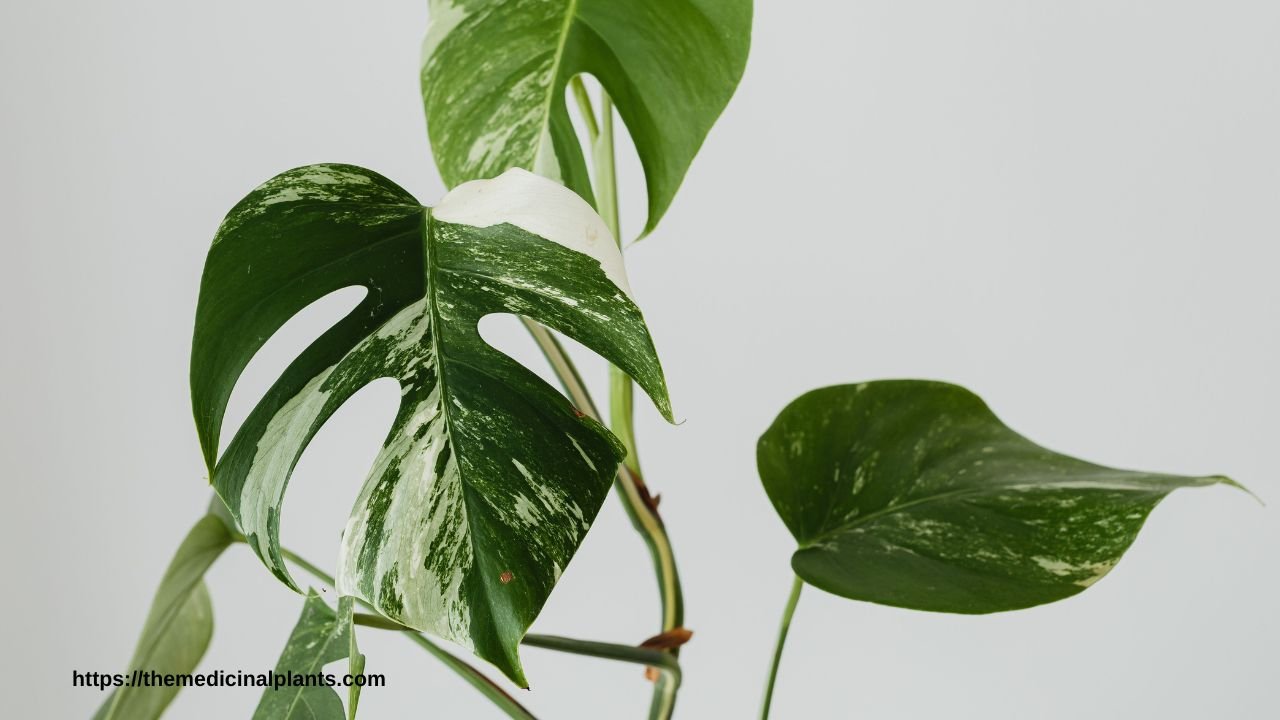
Monstera deliciosa ‘Albo Variegata’ is a perennial, evergreen, climbing aroid house plant cultivated for its large, highly distinctive leaves, which feature irregular white to creamy-white variegation. It develops a thick, climbing stem with aerial roots that help the plant attach to trees and other supports. Mature leaves are large, leathery, deeply cut, and characterized by distinct natural perforations. The white variegation is caused by sections of the leaves lacking normal chlorophyll. Under favorable conditions, the plant produces a characteristic aroid inflorescence consisting of a spathe surrounding a spadix; successful pollination results in the formation of an elongated fruit. It is widely grown as an indoor ornamental plant due to its striking foliage and climbing habit.
Common Names
- Monstera Albo
- Variegated Monstera
- Variegated Swiss
- Cheese Plant
- Variegated Split-Leaf Philodendron
- Albo Monstera
Scientific Name– Monstera deliciosa ‘Albo Variegata’
Parent species: Monstera deliciosa Liebm.
Some Basic Information about Monstera deliciosa ‘Albo Variegata’ - Indoor house plant
Root – Root system consisting of underground roots together with numerous aerial roots arising from the nodes of the climbing stem. Aerial roots are thick, fleshy, and capable of attaching to supporting surfaces and absorbing moisture and nutrients. They also provide additional mechanical support as the plant climbs.
Stem – Stem thick, fleshy, cylindrical, climbing, and branched with age. The stem bears distinct nodes from which leaves, aerial roots, and new shoots arise. Young stems are green and relatively flexible but become thicker and more robust with age. Aerial roots commonly emerge from the nodes and help the plant climb and remain attached to supports.
Leaf – Leaves simple, very large, leathery, glossy, and generally heart-shaped to broadly ovate when mature. Mature leaves develop deep marginal lobes and characteristic internal perforations or fenestrations. The leaf surface is smooth and somewhat glossy, with a prominent midrib and lateral veins.
In ‘Albo Variegata’, portions of the leaf are distinctly white, cream, or pale green because of stable sectoral or marbled variegation. The distribution of variegation can vary considerably from one leaf to another, with some leaves showing large white sectors and others displaying smaller patches or streaks.
Leaf Arrangement – Leaves are arranged alternately along the climbing stem, with each leaf arising from a distinct node. Young leaves are generally smaller and less divided, while mature leaves become considerably larger and develop deeper lobes and characteristic fenestrations.
Inflorescence – Aroid structure consisting of a thick, fleshy spadix surrounded by a modified leaf-like spathe. The inflorescence develops from the stem and is generally produced when the plant reaches sufficient maturity and growing conditions are favorable.
Flower – Small, numerous, and densely arranged on the surface of the spadix. Individual flowers are inconspicuous and closely packed, making the entire spadix appear as a continuous cylindrical floral structure.
Perianth – Perianth absent or highly reduced, as characteristic of many members of the family Araceae. The individual flowers are therefore not surrounded by a conspicuous showy floral covering.
Androecium – Stamens numerous, closely associated with the flowers of the spadix. Anthers produce pollen grains that are released during the flowering process.
Gynoecium – Gynoecium composed of several fused carpels. Ovary superior and embedded within the tissue of the spadix, with the ovules arranged within the ovary. The style and stigma are positioned toward the upper portion of the individual flowers. After successful fertilization, the ovaries develop into the edible fruiting structures that collectively form the characteristic Monstera fruit.
Fruit – Llong, cylindrical, compound structure formed from the numerous closely packed fruits developing along the spadix. When mature, the fruit becomes fleshy and develops a distinctive edible portion with a characteristic tropical flavor. Immature fruit contains calcium oxalate crystals and is not suitable for consumption until properly mature.
Seed – Relatively small and enclosed within the fleshy fruiting structure. Sexual reproduction through seeds is possible, although cultivated ‘Albo Variegata’ plants are commonly propagated vegetatively to maintain their characteristic variegated foliage.
Floral Formula : Br ⚥ P0 A∞ G(∞)
Kingdom – Plantae
Clade – Angiosperms
Order – Alismatales
Family – Araceae
Subfamily – Monsteroideae
Tribe – Monstereae
Genus – *Monstera*
Species – *Monstera deliciosa*
Uses of house plant –Monstera deliciosa ‘Albo Variegata’
- Ornamental Plant – *Monstera deliciosa* ‘Albo Variegata’ is primarily grown as an ornamental plant due to its large, perforated leaves featuring attractive white variegation.
- House plant – It is widely cultivated as a decorative plant in homes, apartments, offices, and other indoor spaces where there is adequate light and support for climbing.
- Specimen Plant – Its exceptionally large leaves and striking white-and-green patterns make it a standout attraction in indoor plant collections.
- Vertical Gardening – Due to its climbing habit and aerial roots, it can be grown on moss poles, trellises, or other vertical supports.
- Tropical Landscaping – In warm, suitable climates, it can be grown in pots, sheltered garden areas, and tropical-style landscapes.
- Plant Collection – Its distinctive, colorful leaves make it popular among ornamental plant enthusiasts and aroid collectors.
Related article
- Comparison Between Hoya, Burro’s Tail, and Wandering Jew Hanging Plants
- Hanging plant- Inch Plant: Floral formula
- Hanging plant- Burro’s Tail: Floral formula
- Hanging plant-Hoya: Floral formula
- Hanging plant-hedera helix: Floral formula
- Hanging plant-Boston Fern: Floral formula
- Hollyhock (Alcea rosea): Plant overview and floral formula
- Helianthus annuus floral formula
- Chillies and Peppers at Home – Step-by-Step Guide
- Tomato at home – step to step Guide
- Chives at Home – Step-by-Step Guide
- Conophytum Succulents at Home: Step-to-Step guide
- Edamame (Young Soybeans)
- Lettuce at Home: Step-to-Step guide
- Brassica campestris at home step to stpe guide