


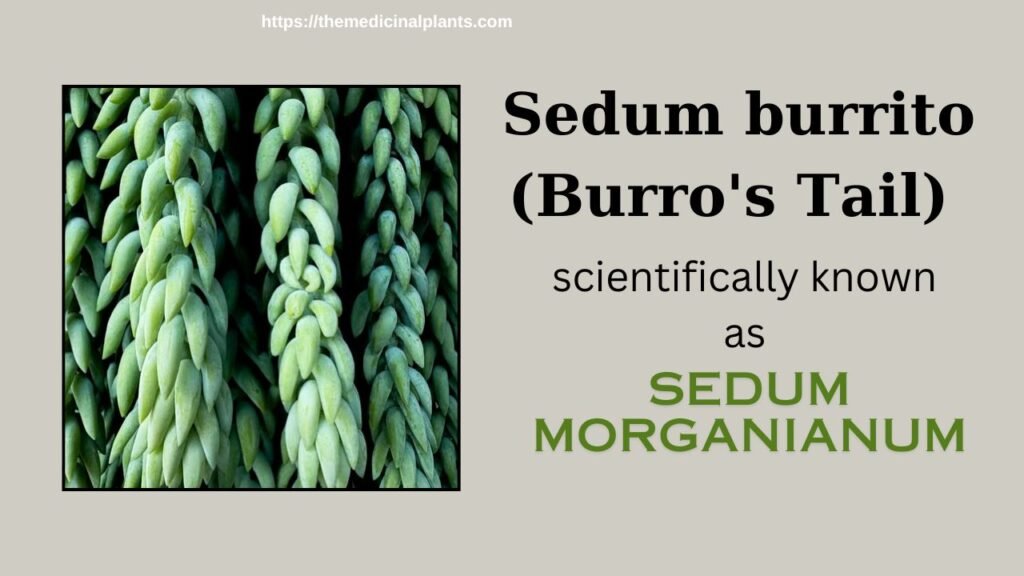
*Sedum burrito*, commonly known as Burro’s Tail, is a beautiful trailing succulent. It is known for its long, cascading stems covered in small, plump, rice-grain-like leaves that spill over the sides of the pot like a waterfall. The leaves of this hanging plants are blue-green or light green and remain fleshy due to their water-storing nature. This plant thrives in bright but indirect sunlight, well-draining soil, and requires minimal watering. Occasionally, small pink or red flowers may appear at the tips during the summer.

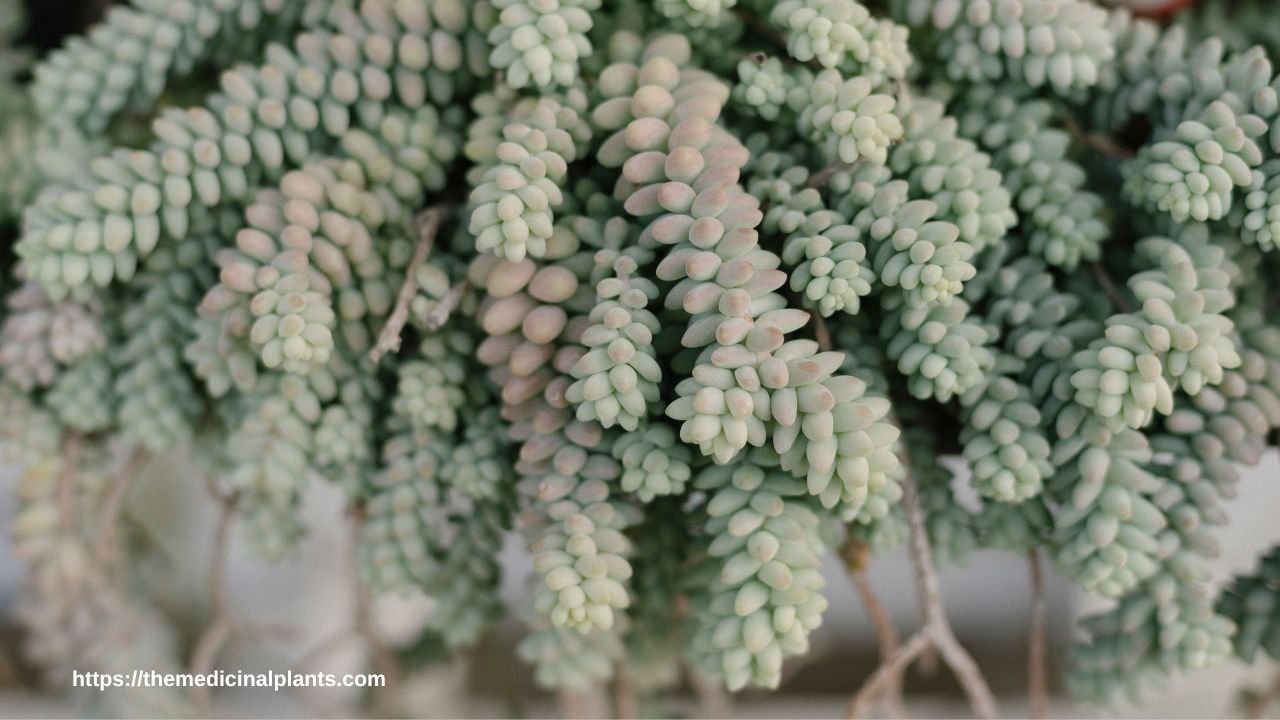
Scientific Name: Sedum morganianum
Some Basic Information about Sedum burrito (Burro's Tail) - Indoor hanging plant
Habit: Perennial, evergreen, succulent trailing herb, usually 30–120 cm in length; forms dense, pendulous stems covered with fleshy leaves, producing attractive cascading growth ideal for hanging baskets, rock gardens, and succulent displays
Root: Fibrous and adventitious, arising from the stem base and occasionally from stem nodes; roots anchor the plant and absorb water efficiently. Detached leaves and stem segments readily develop adventitious roots, enabling easy vegetative propagation
Stem: Trailing, succulent, cylindrical, highly branched, green to bluish-green, flexible when young and becoming slightly woody near the base with age; stems are fragile and densely covered with overlapping leaves
Leaf: Alternate, sessile, simple, cylindrical to oblong-ovoid, 1–2 cm long; margin entire, exstipulate; leaves thick, fleshy, glaucous blue-green to grayish-green, often covered with a waxy bloom (farina) that reduces water loss and protects against intense sunlight
Inflorescence: Terminal or lateral cymes, bearing several pendent flowers near the ends of mature stems
Flower: Bracteate, complete, actinomorphic, bisexual, hypogynous; flowers small, star-shaped, pink to rosy-red with yellow anthers, appearing mainly during spring and summer
Calyx: Sepals 5, free, fleshy, green, persistent, with valvate aestivation
Corolla: Petals 5, free, lanceolate, pink to reddish-pink, pointed at the apex, with valvate aestivation
Androecium: Stamens 10, free, arranged in two whorls; anthers yellow, dithecous, dehiscing longitudinally
Gynoecium: Ovary superior, 5-carpellary, apocarpous; each carpel unilocular with numerous ovules showing marginal placentation; styles 5, slender; stigmas simple
Fruit: Follicles, usually five, dry and dehiscent, containing numerous minute brown seeds
Floral Formula: Br ⊕ ⚥ K5 C5 A10 G5
Systematic Position
Division – Angiospermae
Class – Dicotyledonae
Order – Saxifragales
Family – Crassulaceae
Genus – Sedum
Species – burrito
Related article
- Comparison Between Hoya, Burro’s Tail, and Wandering Jew Hanging Plants
- Hanging plant- Inch Plant: Floral formula
- Hanging plant- Burro’s Tail: Floral formula
- Hanging plant-Hoya: Floral formula
- Hanging plant-hedera helix: Floral formula
- Hanging plant-Boston Fern: Floral formula
- Hollyhock (Alcea rosea): Plant overview and floral formula
- Helianthus annuus floral formula
- Chillies and Peppers at Home – Step-by-Step Guide
- Tomato at home – step to step Guide
- Chives at Home – Step-by-Step Guide
- Conophytum Succulents at Home: Step-to-Step guide
- Edamame (Young Soybeans)
- Lettuce at Home: Step-to-Step guide
- Brassica campestris at home step to stpe guide