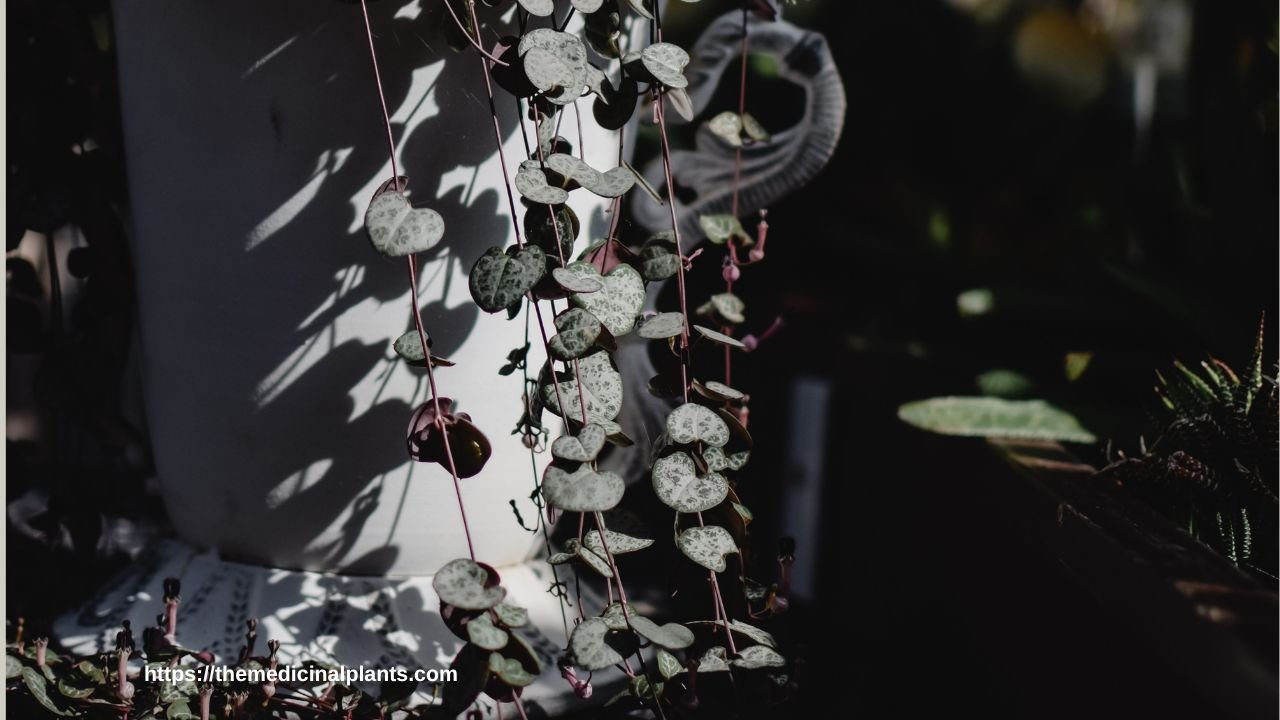
Ceropegia linearis, also known as “String of Needles,” is a slender, trailing hanging plant. Its stems are long, thin, and fleshy, cascading downwards from hanging pots or elevated positions. The leaves are very slender and needle-like—ranging from green to a pale blue-green—and are spaced widely along the stems. As the plant stores water in its leaves and stems, it requires minimal watering. It thrives in bright, indirect sunlight and well-draining soil, though overwatering can cause root rot. With a little care, it is easy to maintain.
Scientific Name: Ceropegia linearis
Some Basic Information about Ceropegia linearis (String of Needles) - Indoor hanging plant
Habit: Perennial, evergreen climbing or trailing succulent herb, usually 1–3 meters in length when provided with suitable support; forms slender cascading stems or twines around nearby vegetation, making it suitable for hanging baskets and trellises
Root: Fibrous with adventitious roots arising from stem nodes; roots are often associated with small underground tubers that store water and nutrients, aiding survival during dry periods
Stem: Climbing, slender, succulent, twining, branched, green to purplish-green, smooth and flexible; stems may root at the nodes when in contact with moist soil and become slightly woody with age
Leaf: Opposite, petiolate to subsessile, simple, linear to narrowly lanceolate, 3–8 cm long; margin entire, exstipulate, fleshy, smooth, and bright green; leaves are succulent and adapted for water storage
Inflorescence: Solitary or few-flowered axillary cymes, borne along mature stems
Flower: Bracteate, complete, actinomorphic to slightly zygomorphic, bisexual, hypogynous; flowers tubular, elongated, greenish-white to pale purple with darker purple markings; corolla lobes united at the tips, forming a lantern- or cage-like structure characteristic of the genus
Calyx: Sepals 5, free, narrow, linear-lanceolate, green, persistent, with valvate aestivation
Corolla: Petals 5, gamopetalous, forming a long inflated tube; lobes narrow and fused at their tips into a cage-like canopy; valvate aestivation
Androecium: Stamens 5, epipetalous, united with the stigma to form a gynostegium; anthers dithecous, producing pollinia, a characteristic feature of the family Apocynaceae
Gynoecium: Ovary superior, bicarpellary, apocarpous at the ovary but united by a common style and stigma; each ovary unilocular with numerous ovules showing marginal placentation; stigma pentagonal
Fruit: Pair of long, slender follicles, containing numerous flattened seeds with silky white hairs (coma) that facilitate wind dispersal
Floral Formula: Br ⊕ ⚥ K5 C(5) A5 G̲2
Systematic Position
Division – Angiospermae
Class – Dicotyledonae
Order – Gentianales
Family – Apocynaceae
Subfamily – Asclepiadoideae
Genus – Ceropegia
Species – linearis
Related article
- Comparison Between Hoya, Burro’s Tail, and Wandering Jew Hanging Plants
- Hanging plant- Inch Plant: Floral formula
- Hanging plant- Burro’s Tail: Floral formula
- Hanging plant-Hoya: Floral formula
- Hanging plant-hedera helix: Floral formula
- Hanging plant-Boston Fern: Floral formula
- Hollyhock (Alcea rosea): Plant overview and floral formula
- Helianthus annuus floral formula
- Chillies and Peppers at Home – Step-by-Step Guide
- Tomato at home – step to step Guide
- Chives at Home – Step-by-Step Guide
- Conophytum Succulents at Home: Step-to-Step guide
- Edamame (Young Soybeans)
- Lettuce at Home: Step-to-Step guide
- Brassica campestris at home step to stpe guide