Scindapsus pictus, also known as Satin Pothos, is a beautiful trailing indoor hanging plant. It features heart-shaped, dark green leaves adorned with silvery spots or patterns that give them a lustrous, satin-like sheen. Much like the common money plant, it looks attractive trailing down walls or trellises, or cascading from hanging pots. While Satin Pothos thrives in low-light conditions, the silvery markings on its leaves appear more distinct in bright, indirect light. It prefers moderate moisture; overwatering can lead to root rot, so it is best to water the plant only when the soil has dried out.
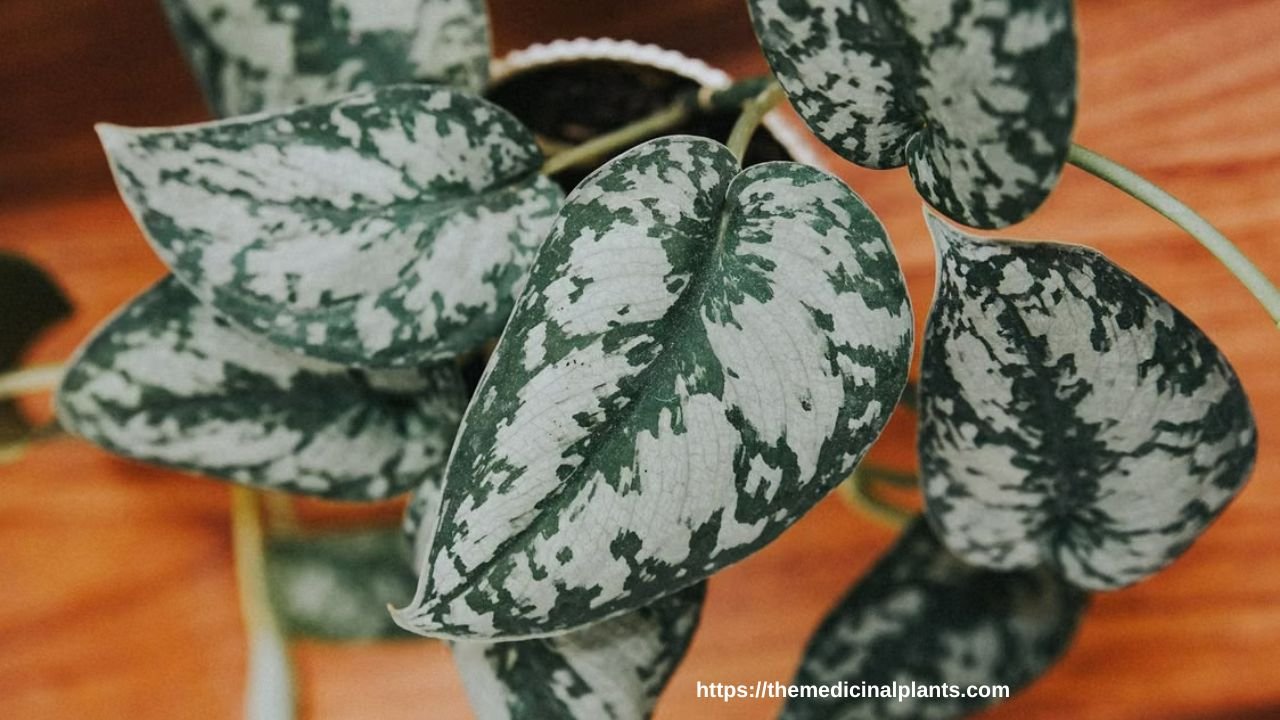
Scientific Name: Scindapsus pictus
Some Basic Information about Scindapsus pictus (Satin Pothos) - Indoor hanging plant
Habit: Perennial, evergreen climbing or trailing herb, usually 3–10 meters in length when provided with suitable support; forms dense cascading vines or climbs tree trunks and other vertical surfaces by means of aerial roots, making it a popular ornamental foliage plant
Root: Adventitious, arising from nodes along the stem; these roots anchor the plant to tree bark, moss poles, walls, or rocks and absorb moisture and nutrients. Fibrous underground roots develop from the stem base
Stem: Climbing, slender, herbaceous when young, becoming semi-woody with age; branched, flexible, green to grayish-green, producing aerial roots at each node that facilitate climbing and attachment
Leaf: Alternate, petiolate, simple, ovate to cordate (heart-shaped), 8–20 cm long; margin entire, exstipulate; leaves thick, leathery, dark green with characteristic silvery-gray variegated spots or patches giving a satin-like appearance; apex acuminate and base cordate
Inflorescence: Solitary axillary spadix enclosed by a spathe; flowering is uncommon in cultivated indoor plants
Flower: Bracteate, complete, unisexual, monoecious, epigynous; flowers minute, sessile, densely arranged on a fleshy spadix and enclosed within a greenish to cream-colored spathe
Calyx: Sepals absent
Corolla: Petals absent, characteristic of the family Araceae
Androecium: Stamens usually 4, free, anthers sessile, dithecous, dehiscing longitudinally
Gynoecium: Ovary superior, tricarpellary, syncarpous, unilocular; placentation parietal; style short or absent; stigma sessile
Fruit: Berry, small, fleshy, ovoid to globose, turning yellowish to orange when ripe; contains several seeds. Fruiting is extremely rare in cultivated plants
Floral Formula: Br ⊕ ⚥ P0 A4 G̲(3)
Systematic Position
Division – Angiospermae
Class – Dicotyledonae
Order – Alismatales
Family – Araceae
Genus – Scindapsus
Species – pictus
Related article
- Comparison Between Hoya, Burro’s Tail, and Wandering Jew Hanging Plants
- Hanging plant- Inch Plant: Floral formula
- Hanging plant- Burro’s Tail: Floral formula
- Hanging plant-Hoya: Floral formula
- Hanging plant-hedera helix: Floral formula
- Hanging plant-Boston Fern: Floral formula
- Hollyhock (Alcea rosea): Plant overview and floral formula
- Helianthus annuus floral formula
- Chillies and Peppers at Home – Step-by-Step Guide
- Tomato at home – step to step Guide
- Chives at Home – Step-by-Step Guide
- Conophytum Succulents at Home: Step-to-Step guide
- Edamame (Young Soybeans)
- Lettuce at Home: Step-to-Step guide
- Brassica campestris at home step to stpe guide