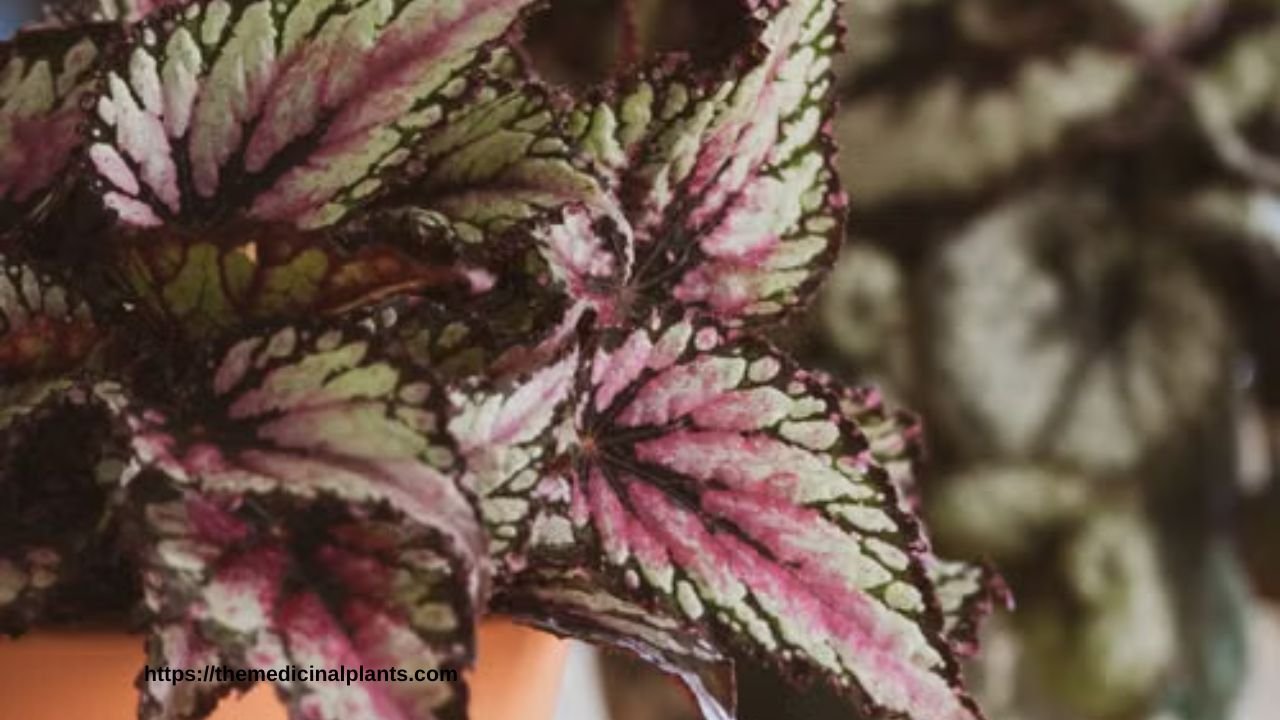
*Cissus discolor*, also known as the Rex Begonia Vine, is a beautiful trailing hanging plant. It is highly popular due to its striking foliage. The leaves are elongated and heart-shaped, featuring a silvery-green sheen on the upper surface and a deep red or purple hue underneath. Beautiful markings and intricate patterns on the leaves make the plant particularly special. It grows as a vine and looks excellent in pots, on trellises, or in hanging baskets. It grows best in light shade, moisture and well-drained soil. Its leaves can get damaged due to strong sunlight.
Scientific Name: Cissus discolor
Some Basic Information about Cissus discolor (Rex Begonia Vine) - Indoor hanging plant
Habit: Perennial, evergreen climbing vine, usually 2–5 meters in length when provided with support; forms attractive trailing or climbing growth and is widely cultivated as an ornamental foliage plant
Root: Adventitious, fibrous roots arising from stem nodes and the basal stem; roots aid in anchorage, water absorption, and vegetative propagation
Stem: Climbing, slender, herbaceous to semi-woody, branched, flexible, green to reddish-purple; stems possess tendrils opposite the leaves that enable the plant to climb supports
Leaf: Alternate, petiolate, simple, ovate to cordate-lanceolate, 8–15 cm long; margin serrate, stipulate; upper surface velvety dark green with striking silver markings along the veins, while the lower surface is deep reddish-purple; apex acuminate and base cordate
Inflorescence: Axillary cymes, small and branched, bearing several inconspicuous flowers
Flower: Bracteate, complete, actinomorphic, bisexual, hypogynous; flowers small, greenish-yellow, and inconspicuous
Calyx: Sepals 4, united at the base, forming a small cup-like structure; valvate aestivation
Corolla: Petals 4, free, greenish-yellow, fleshy, valvate aestivation
Androecium: Stamens 4, free, opposite the petals; anthers dithecous, dehiscing longitudinally
Gynoecium: Ovary superior, bicarpellary, syncarpous, usually bilocular; placentation axile; style short, stigma capitate
Fruit: Berry, small, globose, reddish to purplish-black when ripe, containing 1–4 seeds
Floral Formula: Br ⊕ ⚥ K(4) C4 A4 G̲(2)
Systematic Position
Division – Angiospermae
Class – Dicotyledonae
Order – Vitales
Family – Vitaceae
Genus – Cissus
Species – discolor
Related article
- Comparison Between Hoya, Burro’s Tail, and Wandering Jew Hanging Plants
- Hanging plant- Inch Plant: Floral formula
- Hanging plant- Burro’s Tail: Floral formula
- Hanging plant-Hoya: Floral formula
- Hanging plant-hedera helix: Floral formula
- Hanging plant-Boston Fern: Floral formula
- Hollyhock (Alcea rosea): Plant overview and floral formula
- Helianthus annuus floral formula
- Chillies and Peppers at Home – Step-by-Step Guide
- Tomato at home – step to step Guide
- Chives at Home – Step-by-Step Guide
- Conophytum Succulents at Home: Step-to-Step guide
- Edamame (Young Soybeans)
- Lettuce at Home: Step-to-Step guide
- Brassica campestris at home step to stpe guide